You can want a gentle game without wanting another field to water. Sometimes the appealing part of a farming sim is the little world around it: a path worth following, a room taking shape, a small problem that finally clicks. The crops are simply the bit you could do without.
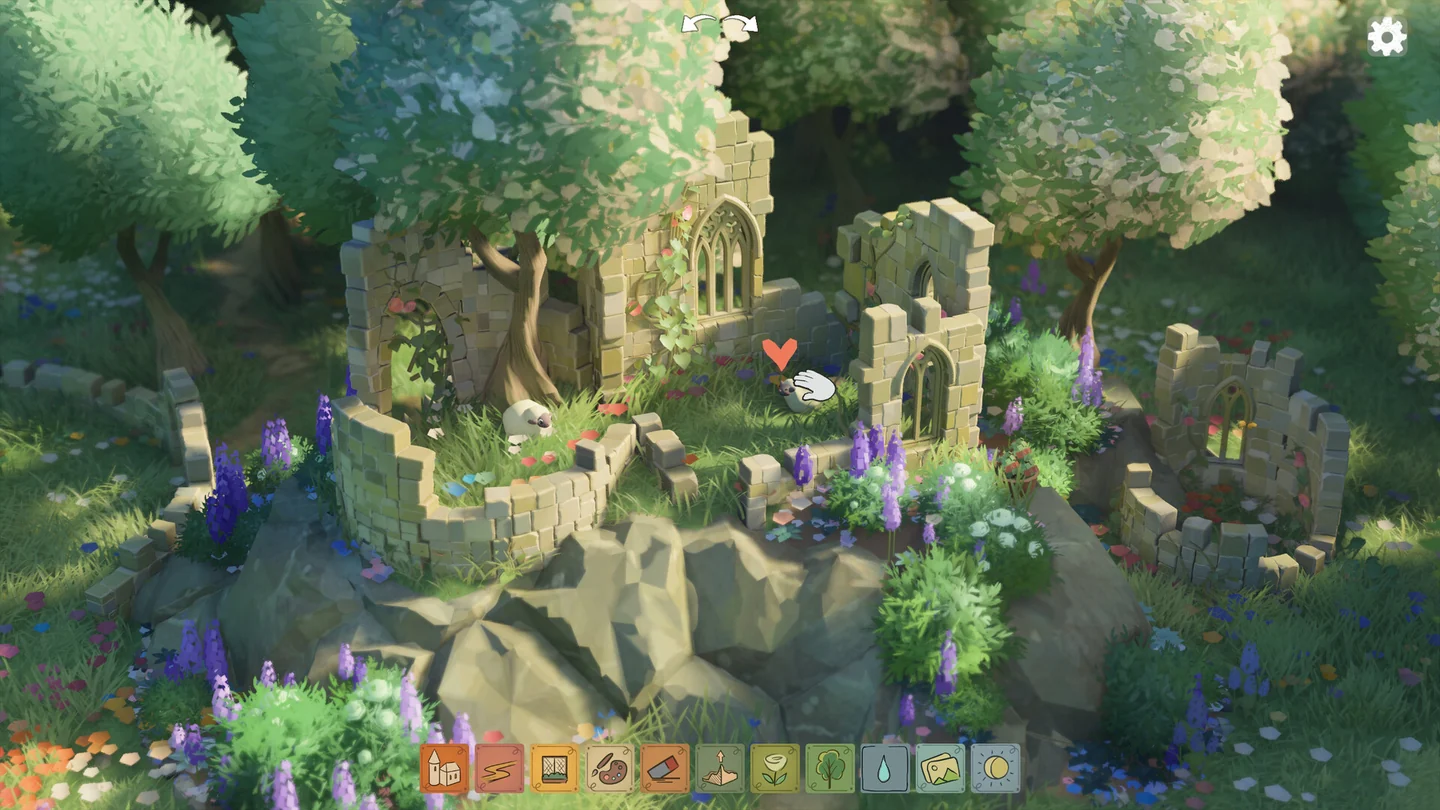
These fifteen games give you something else to do. You might build a cottage without calculating its income, help a mushroom get home, arrange a drawer, or write a kind reply to a stranger. The important distinction is how much the game asks of you. An open canvas can feel freeing; it can also leave you wondering where to begin. A tiny objective can provide direction, until it becomes another thing to optimize.
Choose an activity below, or read through the guide. Each section explains what fills your time, where its sense of comfort comes from, and the part that may make it a poor fit for your evening.
A small adventure, with room to wander
Choose this direction when you want to leave a place feeling that you know it a little better. These games trade crop schedules for paths, small discoveries and characters who need a hand. You will still move through a three-dimensional space and sometimes climb or jump, so a quiet setting does not necessarily mean hands-off play.
01 / A gentle mountain outing with a destination
A Short Hike: a destination you can take your time reaching
The mountain gives A Short Hike a wonderfully simple shape: there is somewhere to go, and an island's worth of reasons to take the long way. You follow paths, climb cliffs, glide over woodland and stop to talk to other visitors. Fishing and swimming offer different ways to linger. The journey has a direction without turning every detour into lost working time.
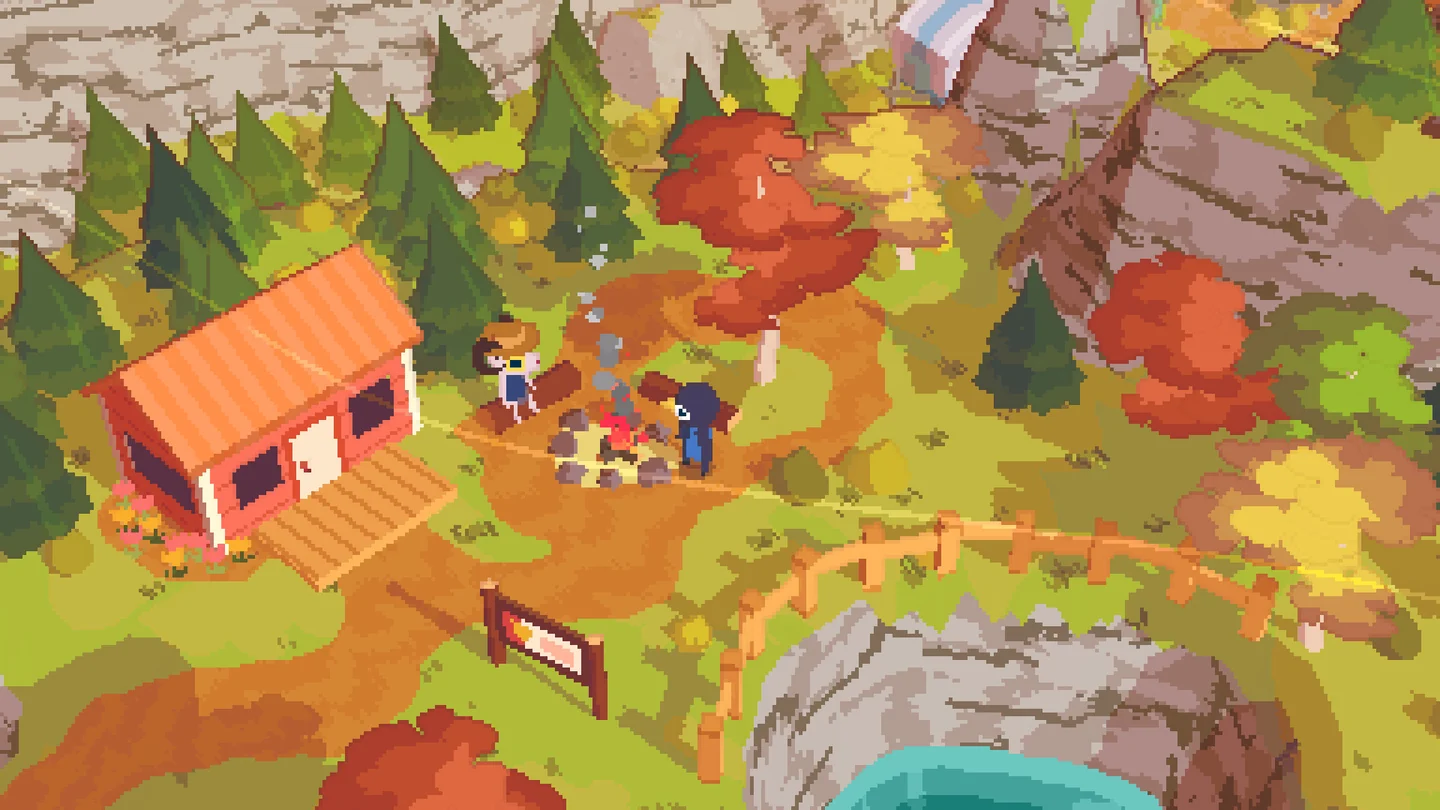
That makes it a useful first choice if an entirely open sandbox leaves you blank. You do not need to invent a grand project before you can enjoy yourself. A nearby trail or another hiker supplies a small reason to move, and the landscape makes movement itself rewarding. It is equally reasonable to spend a while exploring instead of treating the summit as an instruction to hurry.
The tradeoff is that this is still an exploration game, with navigation and climbing. Pick a sorting puzzle instead if moving a character around a landscape is the last thing you want to do. If you like the outing but want a stronger emphasis on playful errands and make-believe, continue to Lil Gator Game.
Game details & sources
Explore A Short Hike on Indie Lantern · Official Steam description
Official promotional screenshot. adamgryu.
02 / Playful quests, climbing and make-believe
Lil Gator Game: turn the whole island into a playground
Lil Gator Game treats adventure as something children make together. You meet other islanders, help with their little quests and bring new friends into a shared game. Cardboard opponents can be knocked down with a toy weapon; scraps become equipment and playground improvements. Climbing, gliding and tumbling make the route between errands part of the fun.
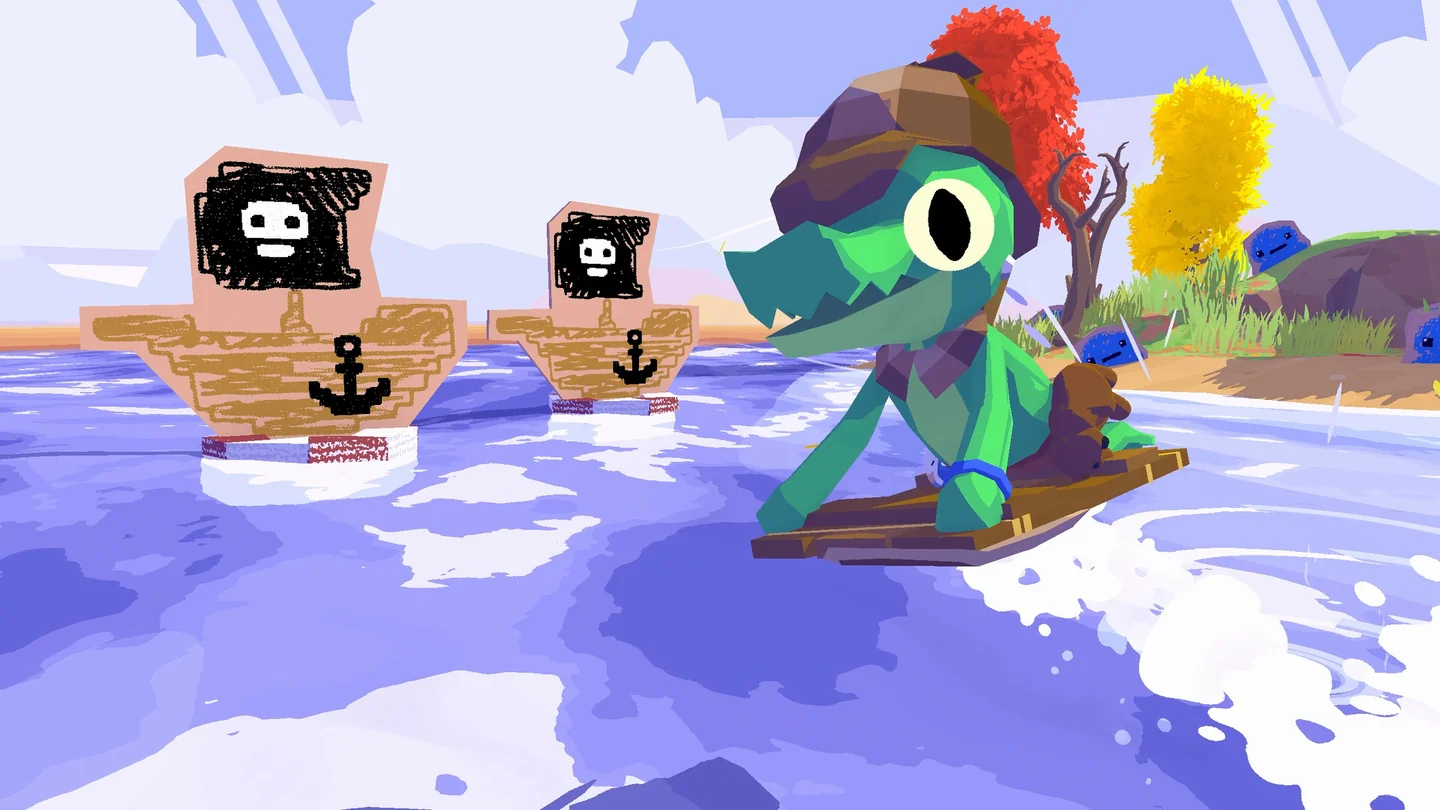
The difference from a farming routine is not that you never gather anything. You do collect craft materials. The difference is what those materials are for: building out a playful afternoon rather than maintaining a field through another productive day. The developer describes the adventure as free of the pressure of a health bar, which fits its pretend-hero setup.
Choose it when you want gentle direction and a generous supply of people to help. Consider A Short Hike if you would rather follow fewer social errands, or Tiny Glade if you want to create without roaming for materials. The cardboard fights are playful, but this is not a completely action-free activity: you still steer, climb and swing your stick.
Game details & sources
Explore Lil Gator Game on Indie Lantern · Official Steam description
Official promotional screenshot. MegaWobble / Playtonic Friends.
03 / A mushroom journey with light platforming
Smushi Come Home: make the forest feel enormous
Playing a tiny mushroom changes the scale of an ordinary walk. A slope, a gap or a patch of undergrowth becomes part of the route home. Smushi runs, climbs, glides and swims through the forest, meeting creatures who may provide help or ask for it. The game mixes that travel with light puzzles and platforming, so finding a way through matters more than tending a plot of land.
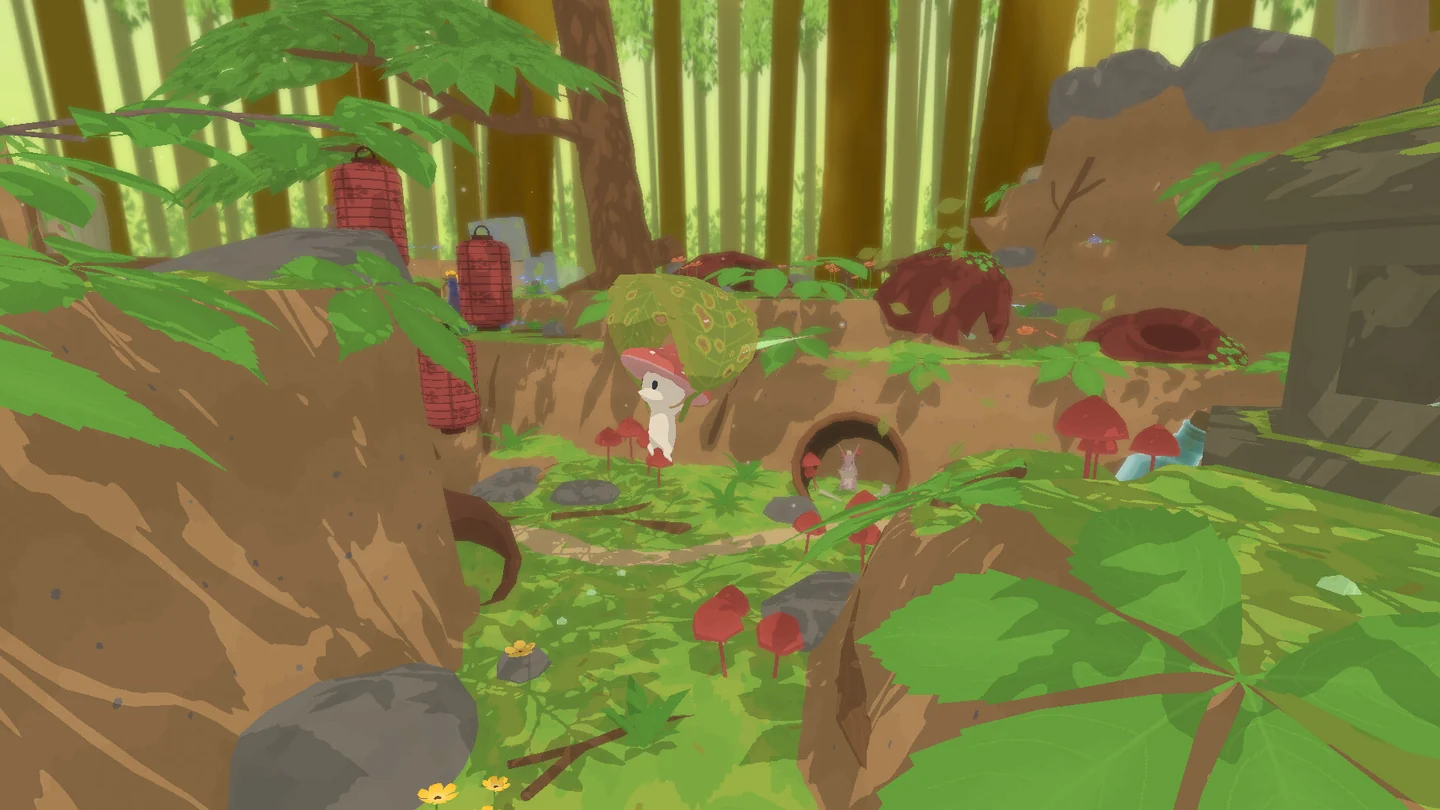
There is a clear reason to keep exploring: Smushi is trying to get home. That gives the scenery a purpose without requiring you to plan the productivity of an entire village. The Mycology Journal also offers a different kind of collecting, introducing real mushrooms rather than asking you to build a crop schedule. Unlockable cap appearances add a small personal touch to the journey.
This is a good bridge between a walk and a puzzle adventure. Choose it if you enjoy noticing a route and working out how your movement tools fit it. If even light platforming gets in the way of relaxing, Spring Falls keeps its landscape on a puzzle board, while Kind Words removes character movement altogether.
Game details & sources
Explore Smushi Come Home on Indie Lantern · Official Steam description
Official promotional screenshot. SomeHumbleOnion / Mooneye Studios.
04 / Explore a city through a curious cat
Little Kitty, Big City: let curiosity set the route
Little Kitty, Big City has the sensible objective of finding a way home, and the much more compelling possibility of getting distracted on the way. You explore the city as a cat, meet other animals, complete their requests and investigate whatever looks worth pawing at. Hats, sunny nap spots and the freedom to cause a little trouble make the city an invitation to nose around.
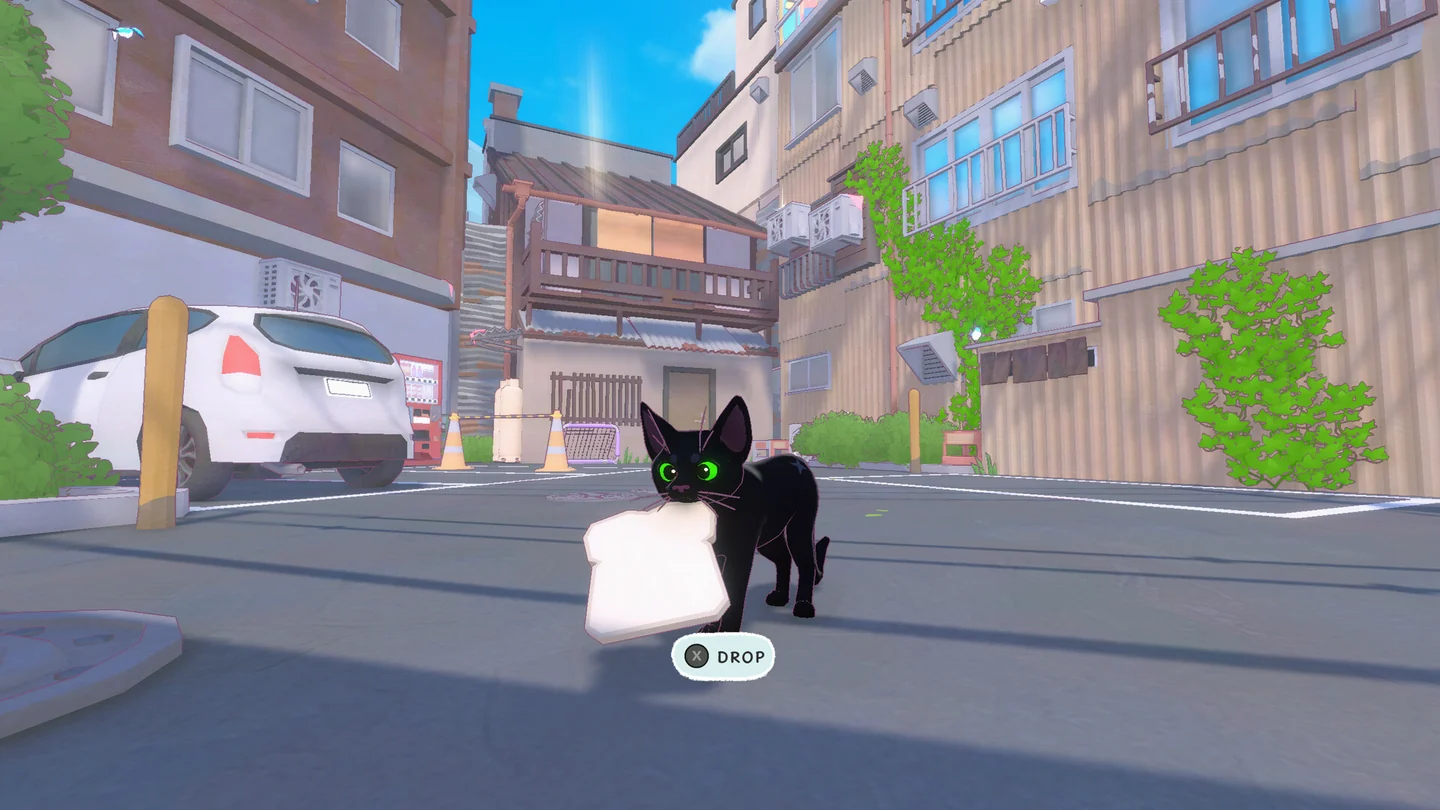
Its particular appeal is the change of perspective. A street becomes a network of small opportunities instead of a route between production buildings. The screenshot's cat carrying an object is a better introduction to that pleasure than a list of cozy labels: this is a game about inhabiting a curious creature and seeing what you can do with the place around you.
Choose it when gentle mischief sounds more appealing than being an efficient helper. You still have exploration controls and quests, so it is not an idle cat ornament for the corner of your screen. Cats Organized Neatly offers the opposite: the cats stay inside a single puzzle, and your job is to find where they fit.
Game details & sources
Explore Little Kitty, Big City on Indie Lantern · Official Steam description
Official promotional screenshot. Double Dagger Studio.
A satisfying problem you can put down
Sometimes the most restful thing is knowing what “done” looks like. These games provide small, defined problems instead of a world that continually needs maintaining. Their calm presentation does not remove the thinking: if searching for an intended answer feels like work, the freeform building section may suit you better.
05 / Household pattern puzzles with hints and skipping
A Little to the Left: order, with an occasional interruption
Sorting books, stacking objects and arranging a tray can make an ordinary household mess into something satisfying to inspect. A Little to the Left builds puzzles around those arrangements. You look for a visual rule, move the objects and see whether the game accepts your solution. Some puzzles have multiple answers, but your favourite arrangement is not automatically a valid one.
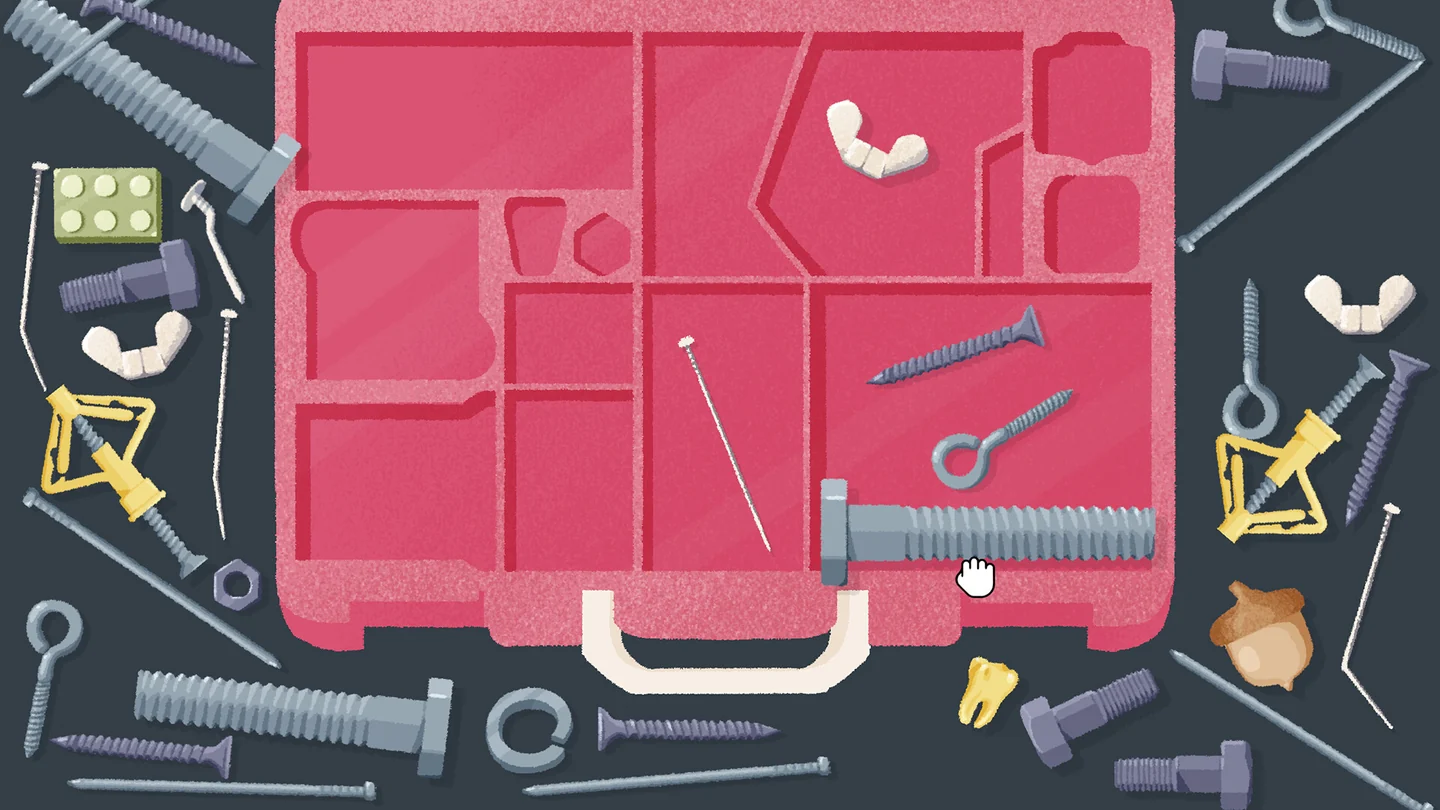
That distinction matters. This is not a free decorating tool in which every choice is equally correct. It is a pattern game, with the pleasure and occasional sticking point that implies. The current feature list includes hints for solutions and Let It Be, which lets you skip a difficult level. Those options are useful if a pleasant task turns into an evening of staring at one stubborn object.
Start here if you want a contained objective and enjoy looking closely at everyday shapes. The mischievous cat can disrupt the tidying, so perfect order is not entirely safe from comedy. If you would prefer an explicit space-fitting rule to interpreting the designer's pattern, Cats Organized Neatly is the clearer next comparison.
Game details & sources
Explore A Little to the Left on Indie Lantern · Official Steam description
Official promotional screenshot. Max Inferno / Secret Mode.
06 / Fit and rotate cats on a small board
Cats Organized Neatly: a small grid, a precise question
Here the problem is wonderfully concrete: fit the cats into the available space. You pick them up, rotate them and work out how their different shapes can share a grid. The hand-drawn animals give the exercise warmth, but the underlying appeal is spatial reasoning. A difficult arrangement becomes manageable as you notice which pieces can occupy an awkward corner.
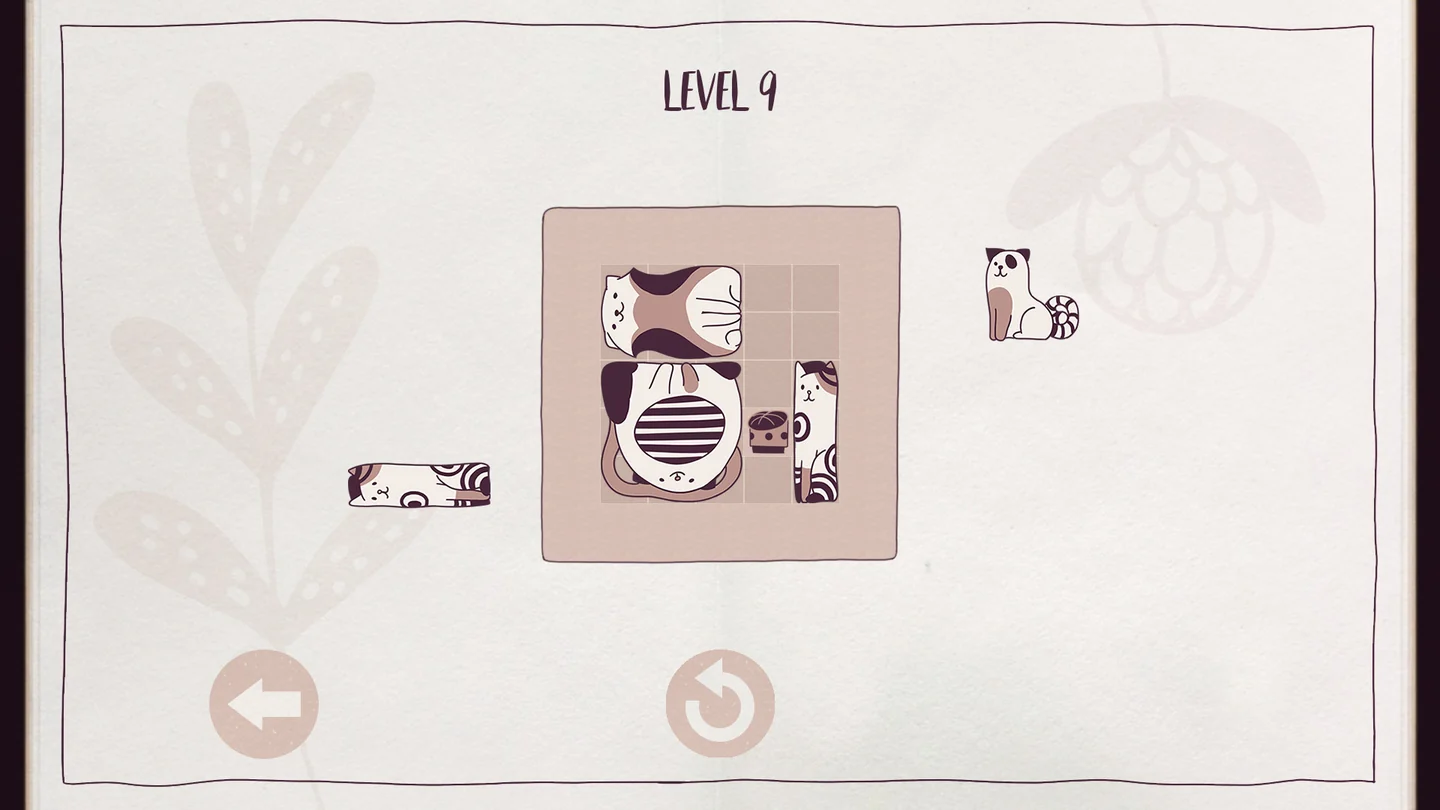
The official description lists 80 handcrafted levels and mouse controls for moving and rotating the cats. That structure gives you a natural stopping point. You can finish a board and decide whether you want another, rather than worrying that a workshop or field has been left unattended. There is no need to understand a shop economy before the central task makes sense.
Choose it if your ideal small achievement is seeing every piece settle into place. It still asks you to solve something: being covered in cats does not make a tight packing puzzle effortless. A Little to the Left offers more variety in the rule you are discovering, while Spring Falls replaces the pieces with a landscape and flowing water.
Game details & sources
Explore Cats Organized Neatly on Indie Lantern · Official Steam description
Official promotional screenshot. DU&I.
07 / A landscape puzzle about water, not crop schedules
Spring Falls: grow flowers by solving the landscape
Spring Falls is the important exception to a simple “no plants” rule. It is about helping wildflowers grow, but it is not a crop-management game. The puzzle is water and terrain. You manipulate a mountainside, working out how changes to the landscape will let water reach the places that need it. The flowers are the result of understanding that little environment.
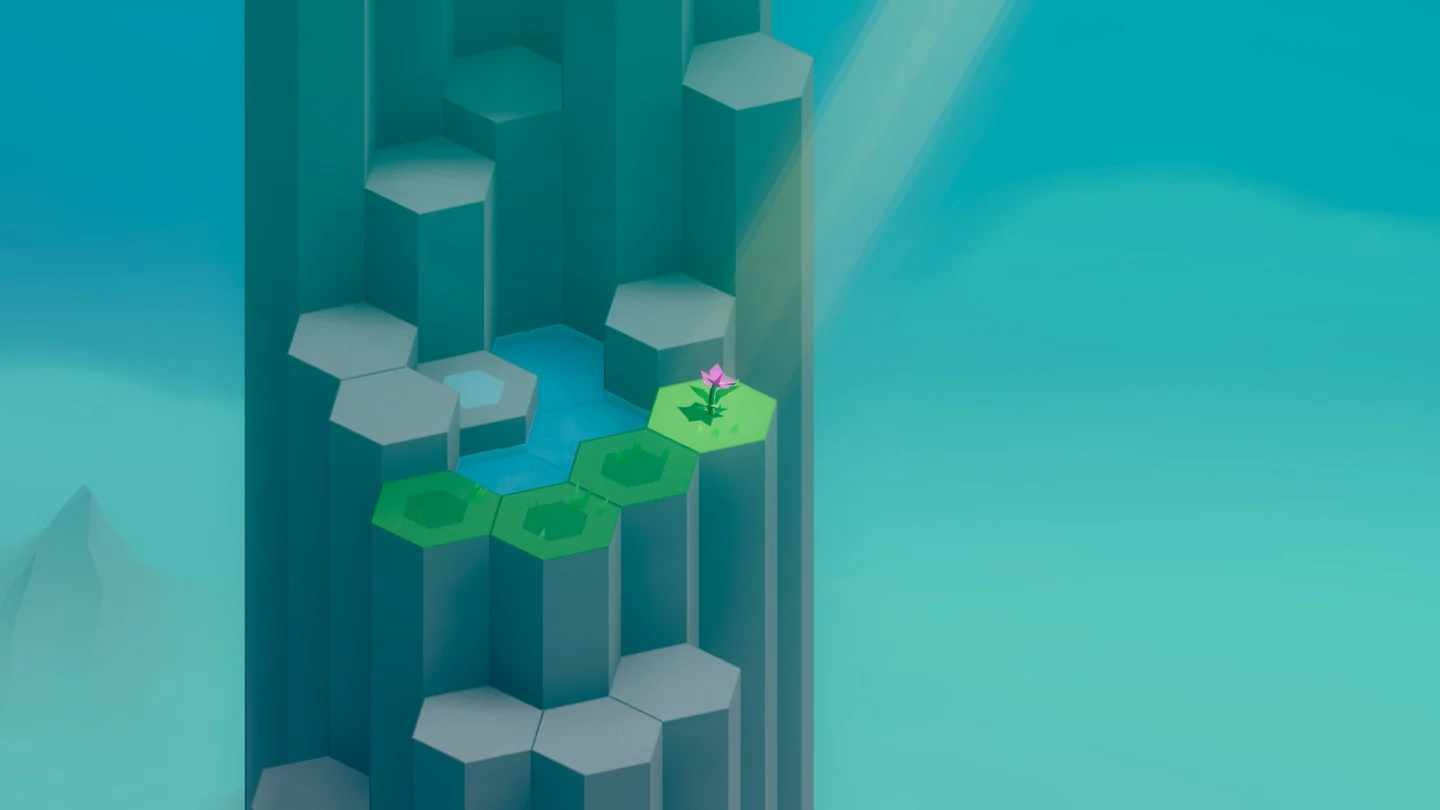
Its 60 handcrafted levels give the process a defined shape. The developer pairs the water-flow mechanic with soft scenery, environmental sounds and an ambient-folk soundtrack. That combination makes it a strong option when you want to concentrate on a small system without switching between inventories, customers and a village's worth of responsibilities.
Choose it if farming fatigue means you dislike repeated chores and profit calculations, rather than the sight of greenery. Skip it if the activity of making plants grow is exactly what you want a break from. For a puzzle with a more obvious story pulling you onward, Lost in Play gives each new situation a different setting and a different little problem.
Game details & sources
Explore Spring Falls on Indie Lantern · Official Steam description
Official promotional screenshot. SPARSE//GameDev.
08 / Cartoon scenes and authored puzzle progression
Lost in Play: let the next strange scene pull you onward
A brother and sister's journey home becomes an excuse for a succession of impossible encounters. Lost in Play asks you to explore its animated scenes, spot useful details, solve puzzles and take part in small games. A pirate seagull or a toad's tea service can be the next reason to pay attention, rather than another resource requirement appearing on a checklist.
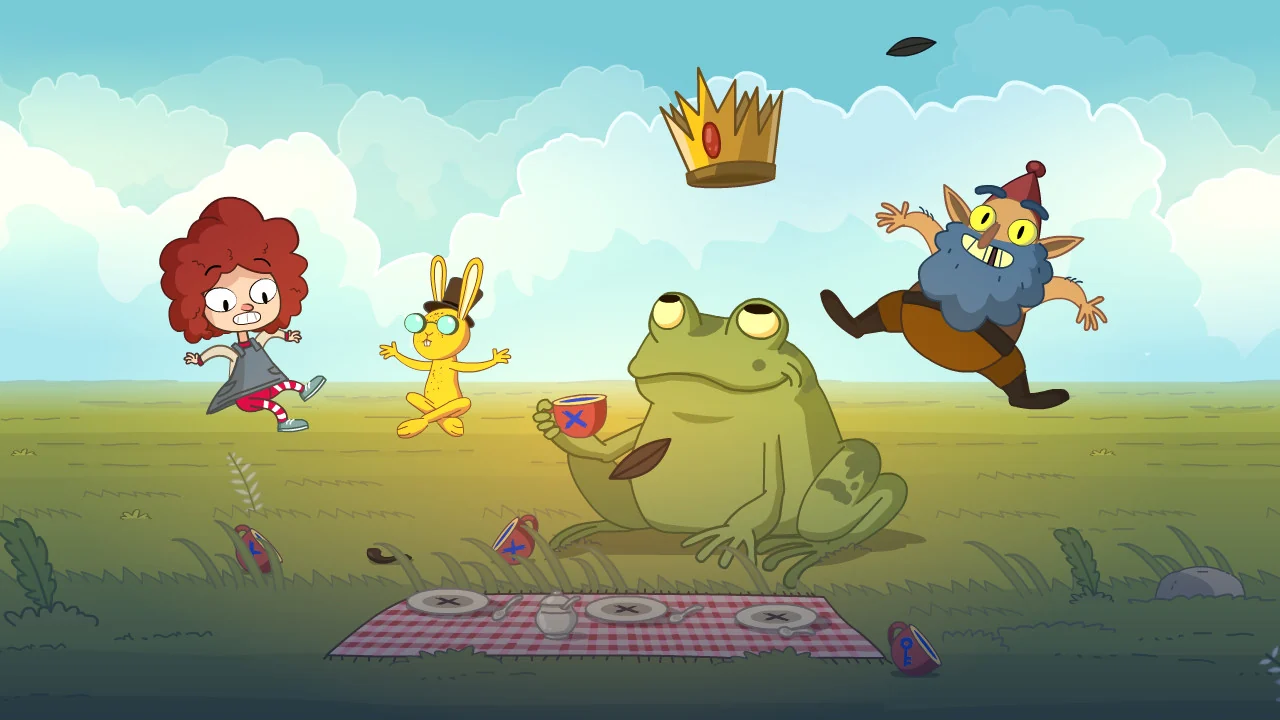
Its strength in this selection is variety. You are not performing one soothing action forever; you are moving through an adventure that keeps changing the situation around you. The cartoon style makes observation enjoyable in its own right, while the puzzles provide a reason to examine the scene instead of simply waiting for the next animation.
Choose it when you want an authored journey and visual humour. The siblings are the story's two protagonists, not a promise of two-player co-op. Puzzles and little games still demand attention, so this is a poor fit if you want to switch off all problem-solving. Pine Hearts offers another story-led direction, with a stronger emphasis on exploration, memories and helping people around a place.
Game details & sources
Explore Lost in Play on Indie Lantern · Official Steam description
Official promotional screenshot. Happy Juice Games / Joystick Ventures.
Make a place that feels like yours
Tiny Glade and Minami Lane can both make you want to pause and look at what you have built. They differ in what the buildings are for. One gives you a scene to shape; the other gives you residents and shop decisions to respond to. Choose between freedom and feedback before choosing between their attractive streets.
09 / Freeform building without management or failure
Tiny Glade: building can be the whole point
Tiny Glade lets you shape a small scene without first establishing a functioning economy. You draw paths, change terrain and assemble buildings while the game adapts the details around your choices. The developer's example of a path passing through a building and creating a doorway captures the appeal: one gesture can suggest what to try next.
There is no management, combat or failure state in its stated design. You can change your mind rather than accept an expensive mistake. An evening's project might be a cottage by a wall or a cluster of towers; those are ideas you bring, not missions the game needs you to finish. Looking at the finished scene is part of the reward.
Choose it if inventing a small project sounds restful. If an empty canvas leaves you waiting for instructions, that freedom may be the very thing you dislike. A Tiny Glade player discussion contains both reactions: some wanted goals, while others saw their absence as the attraction. Minami Lane's missions give you a concrete alternative without returning you to the farm.
Game details & sources
Explore Tiny Glade on Indie Lantern · Official Steam description
Official promotional screenshot. Pounce Light.
10 / A small street with mission feedback or a sandbox
Minami Lane: give the neighbourhood something it needs
Minami Lane builds a compact management game around a Japanese-inspired street. You add homes, shops and attractions, then pay attention to how the residents respond. A ramen shop is not only a lovely building: its stock, recipe and price are decisions. Feedback from a day on the street gives you something specific to change for the next one.
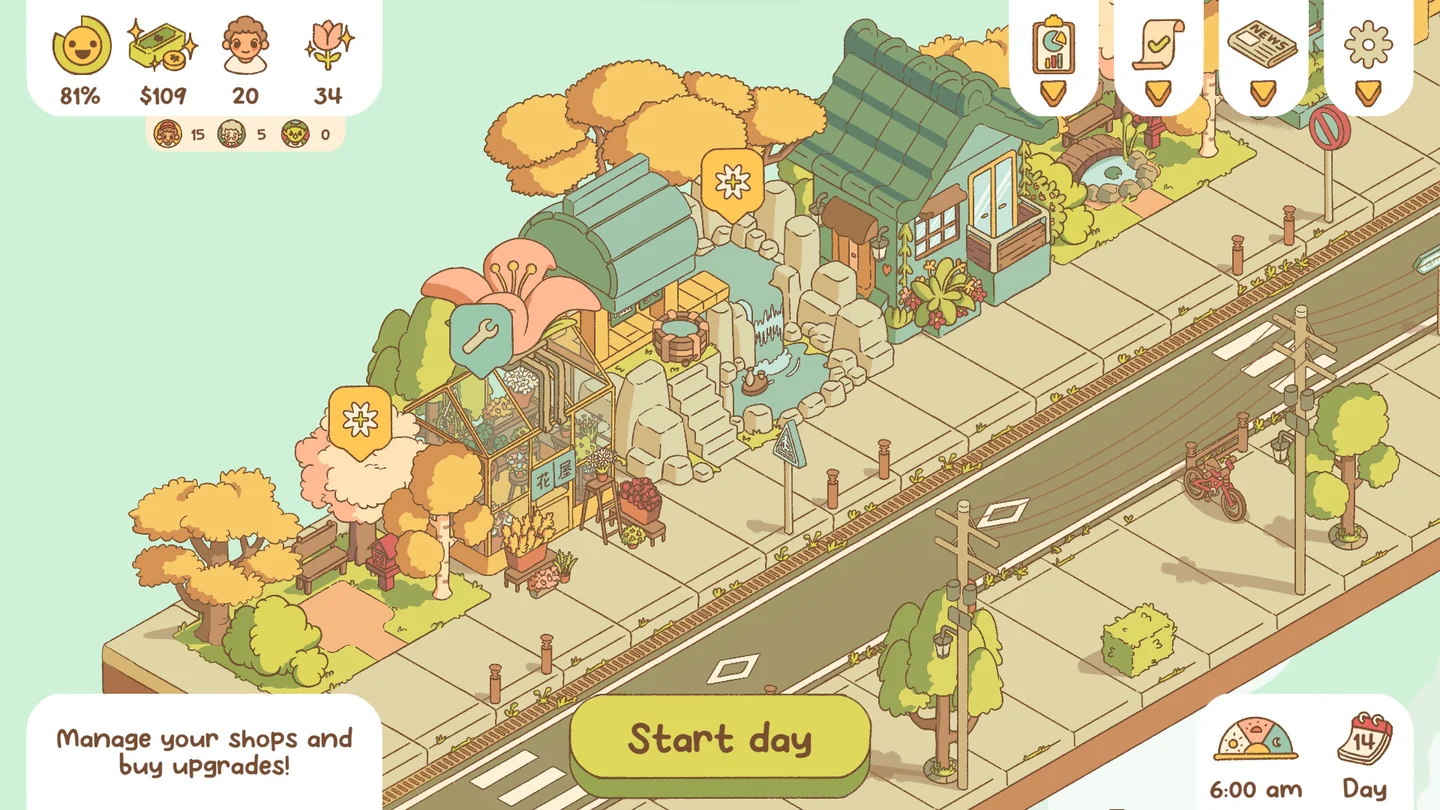
That creates a different kind of satisfaction from Tiny Glade's freeform construction. You are improving a place for the people living in it, and the mission objectives make that improvement legible. The separate sandbox offers a more creative direction. Neither mode requires a crop-growing loop, but missions still involve responding, planning and some optimization.
Choose it when you want a modest management problem and visible neighbourhood life. Choose Tiny Glade if you mainly want to arrange a beautiful scene on your own terms. Minami Lane is single-player, and the developers describe a compact experience rather than a vast supply of missions. That is useful to know if your hope is a game that will become your next long-term routine.
Game details & sources
Explore Minami Lane on Indie Lantern · Official Steam description
Official promotional screenshot. Blibloop / Doot / Doot Tiny Games / Wholesome Games Presents.
Keep the ritual, change the work
If you like repeating a small activity but no longer want that activity to be harvesting, these two games replace the field with something more personal. They still contain routine and care. Decide whether designing orders or looking after strange pets sounds like a welcome ritual rather than another obligation.
11 / Design stickers, arrange sheets and pack orders
Sticky Business: put your taste into something small
Sticky Business turns a sticker shop into a sequence of creative decisions. You combine graphics into your own designs, arrange printable sheets, pack customer orders and add little extras to the parcels. New graphics and finishes expand what you can make. The reward is not simply having sold something: it is seeing a small visual identity emerge from the designs you keep choosing.
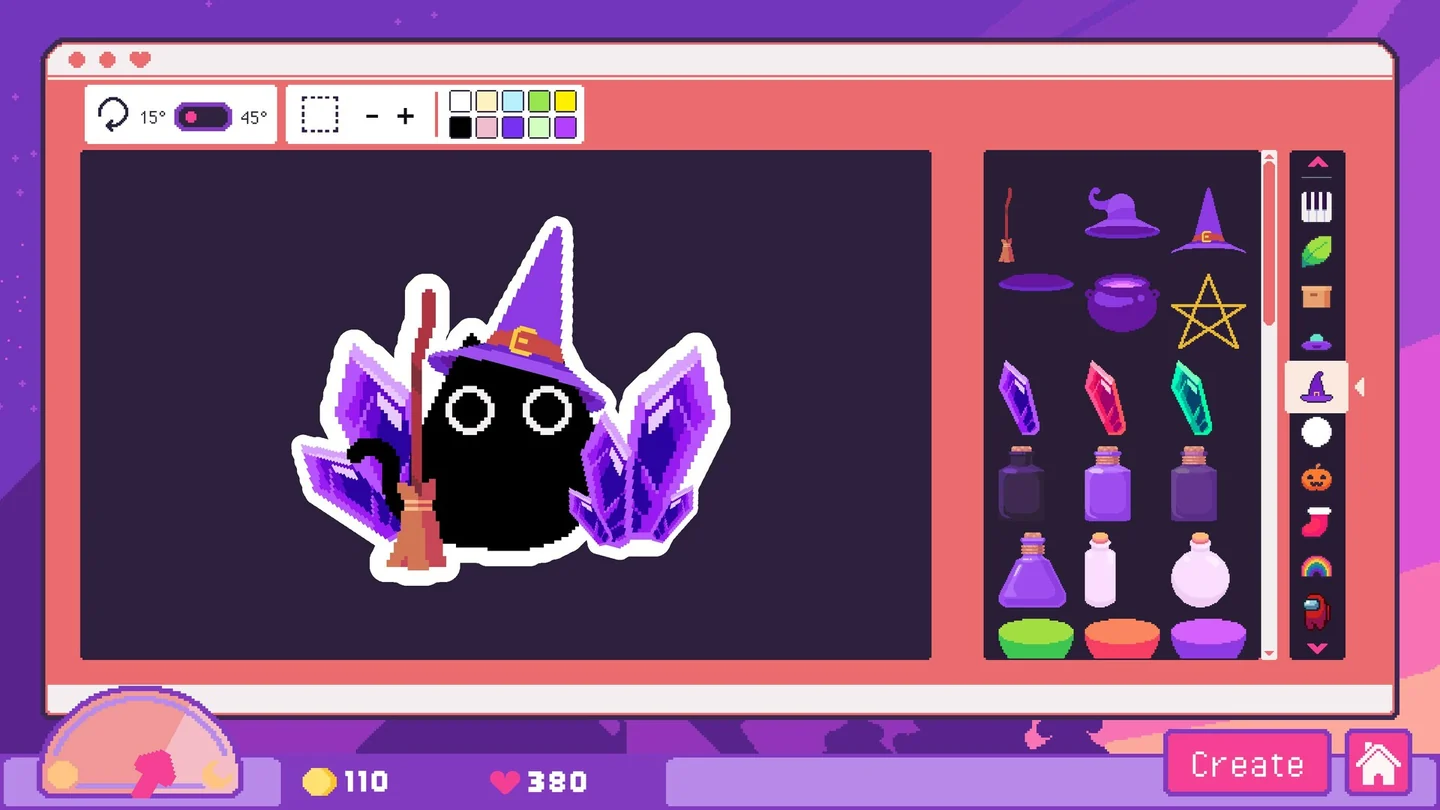
There is enough structure to make those choices useful. Different stickers attract different customers, and repeat orders reveal more of their stories. Sheet layout and resource use also matter, so the business gives your creativity a practical setting. You can enjoy making a theme for your shop rather than starting from an entirely blank canvas every time.
Choose it if assembling and packaging sound satisfying in themselves. Repetition remains central, and swapping a harvest for an order queue will not suit everyone who is tired of chores. If selling and resource use are the parts you want to avoid, Tiny Glade provides a freer creative alternative. If caring for a little living system appeals more, Wobbledogs goes in a much stranger direction.
Game details & sources
Explore Sticky Business on Indie Lantern · Official Steam description
Official promotional screenshot. Spellgarden Games / Assemble Entertainment.
12 / Pet care and strange sandbox experiments
Wobbledogs: a pet sandbox with an unruly imagination
Wobbledogs starts with virtual pets and quickly becomes an experiment in peculiar bodies and behaviour. Food influences the flora in a dog's gut, which in turn influences mutations as it develops. You build and connect rooms, add objects and watch how dogs with different shapes and personalities interact with their surroundings. The screenshot's brightly coloured creatures make the game's tone fairly clear.
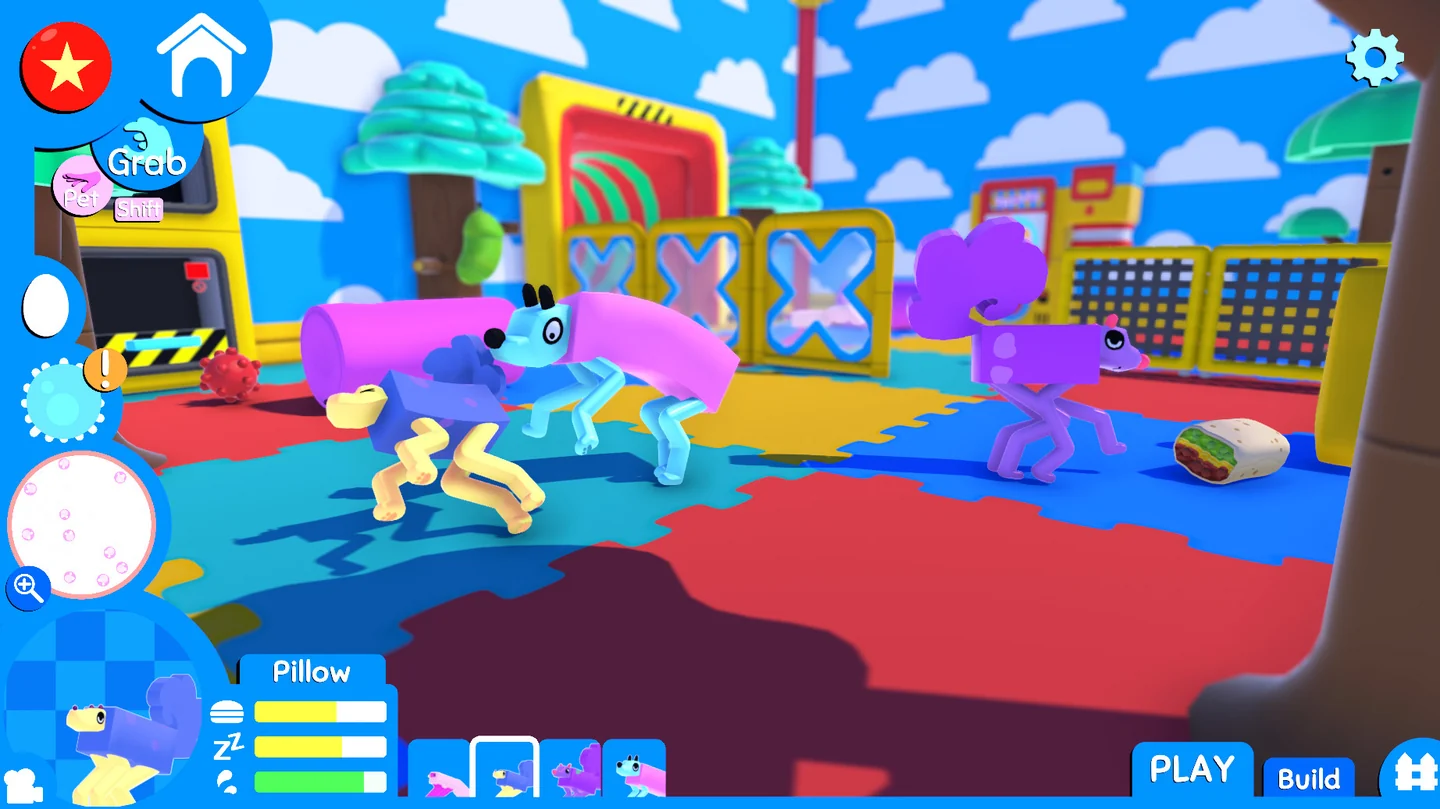
There are no built-in goals in the developer's description, so observing the results can be as important as working toward a particular outcome. You might enjoy creating a habitat or following an unusual family line. This is a more hands-on sort of sandbox than simply placing buildings: animals, food and their development are the material you are experimenting with.
Choose it for affectionate weirdness and emergent behaviour. Consider a different pick if “no farming” means no feeding, breeding or animal-care systems at all. It would be misleading to treat every cozy-looking creature game as an escape from upkeep. For creativity without pet responsibilities, return to Tiny Glade; for something more reflective, try the stories and conversations below.
Game details & sources
Explore Wobbledogs on Indie Lantern · Official Steam description
Official promotional screenshot. Animal Uprising / Secret Mode.
Stories, company and a little absurdity
Cozy can describe an atmosphere without promising that every feeling will be light. These games offer a reason to care about a person, a place or another player's words. One deals with loss, one with everyday worries, and one with an enthusiastically ridiculous car project. Choose the kind of company you actually want.
13 / A nature-reserve story that includes family loss
Pine Hearts: explore somewhere that holds memories
Pine Hearts follows Tyke around a nature reserve tied to childhood holidays and memories of his father. You explore a network of paths and shortcuts, help locals and take on small tasks around beaches, campsites and ruins. The place gives you practical things to do while its story gives the return visits a personal meaning.
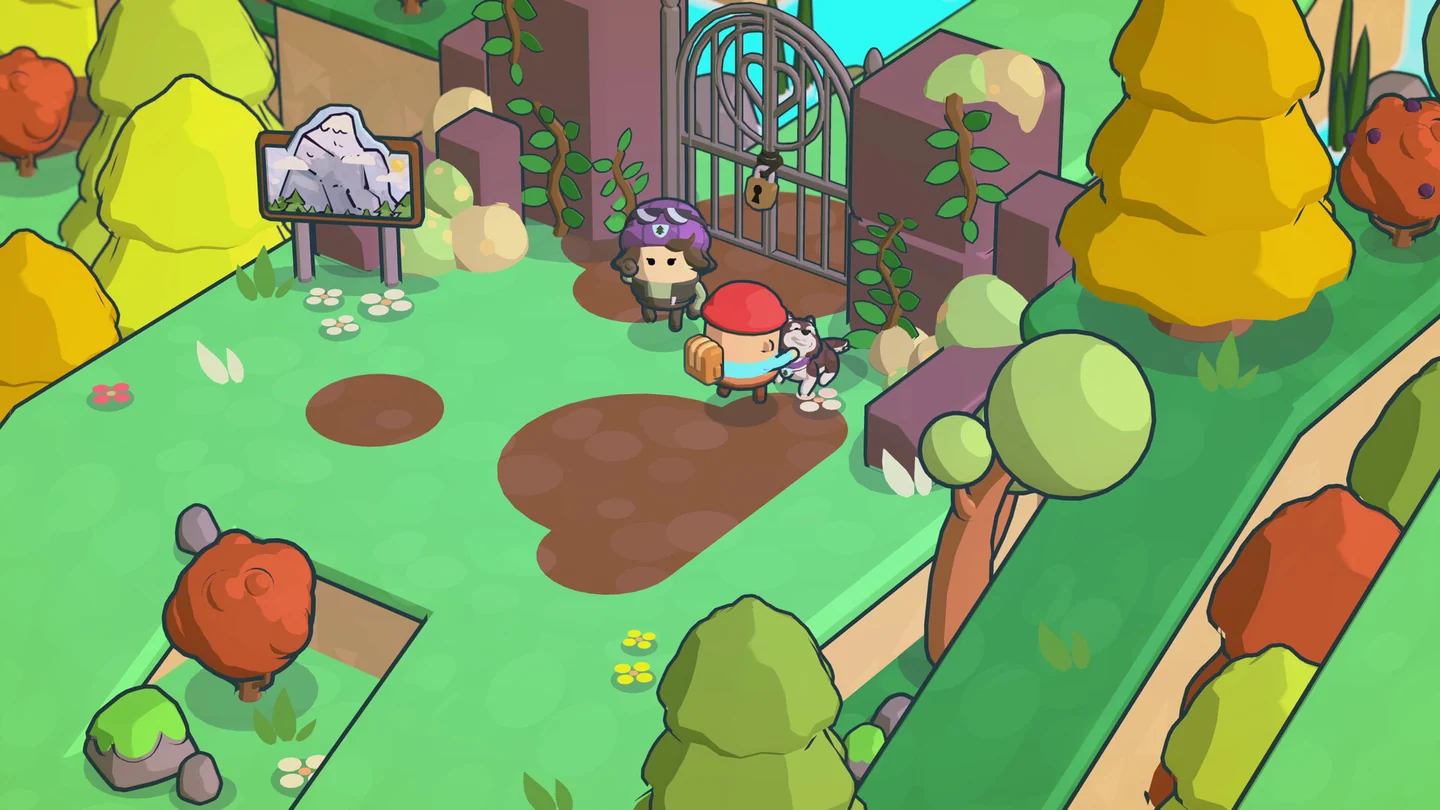
That combination can suit someone who wants a gentle adventure with more emotional direction than a completely open sandbox. Cleaning up a campsite, investigating a cave or helping with a local problem makes exploration feel connected to the people and history of the reserve. The aim is not to turn it into an efficient farm, even when some activities involve gathering or improving a place.
Choose it if a warm setting and an emotional story are part of what you want from a quiet game. Its account of family loss is also the clearest reason to choose something else on a particular evening. If you want nature without that theme at the centre, A Short Hike or Smushi Come Home is an easier starting comparison.
Game details & sources
Explore Pine Hearts on Indie Lantern · Official Steam description
Official promotional screenshot. Hyper Luminal Games Ltd / Secret Mode.
14 / Warm absurdity with more movement and driving
Tiny Terry's Turbo Trip: a change of pace, not a lullaby
Terry has a car, an improbable ambition and a town full of distractions. You explore Sprankelwater on foot, by car or with a paraglider, meet its odd residents and collect Turbo Junk to upgrade the car's boost. Catching insects, digging and finding new things to wear fill out a world built around curiosity and comic encounters.
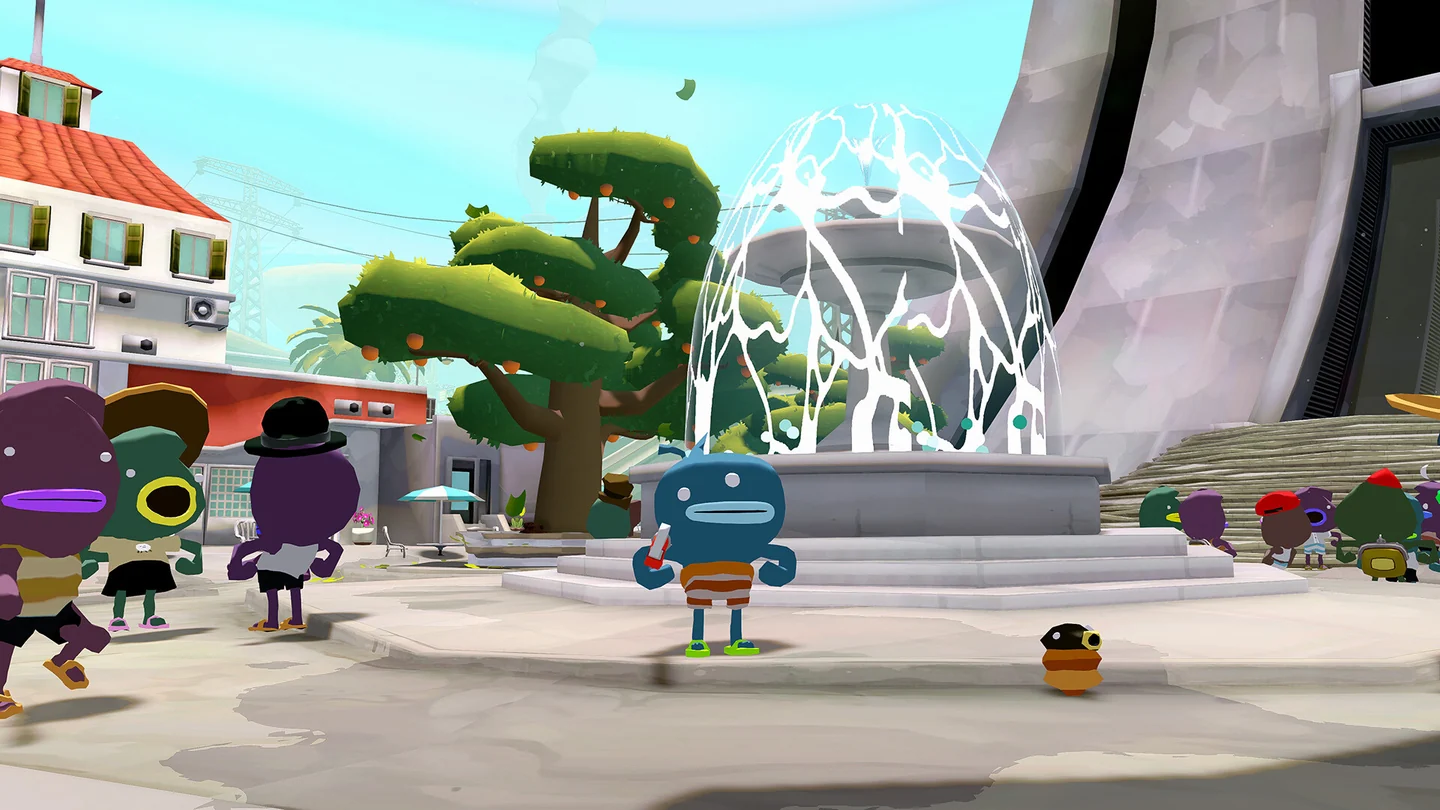
This is the energetic edge of the collection. It belongs here for its playful exploration and warm absurdity, not because it promises the stillness of a mountain puzzle. Driving around and chasing an excessive vehicle upgrade can be a pleasant change from managing crops, especially when the town itself keeps supplying something strange to investigate.
Choose it if your idea of comfort includes a little nonsense and movement. Consider A Short Hike if you want a gentler landscape outing, or Cats Organized Neatly if you would prefer to keep your attention on one small board. A funny, colourful game can still be the wrong fit for an evening when you want quiet hands and very little input.
Game details & sources
Explore Tiny Terry’s Turbo Trip on Indie Lantern · Official Steam description
Official promotional screenshot. snekflat / Super Rare Originals.
15 / Anonymous letters, replies and real human worries
Kind Words: make a small space for someone else
The original Kind Words is built around anonymous requests and replies. You read what another player has chosen to share, write a short response and exchange little tokens of appreciation. Stickers become part of a collection of room decorations, while the music and miniature room provide a calm setting for the act of writing.
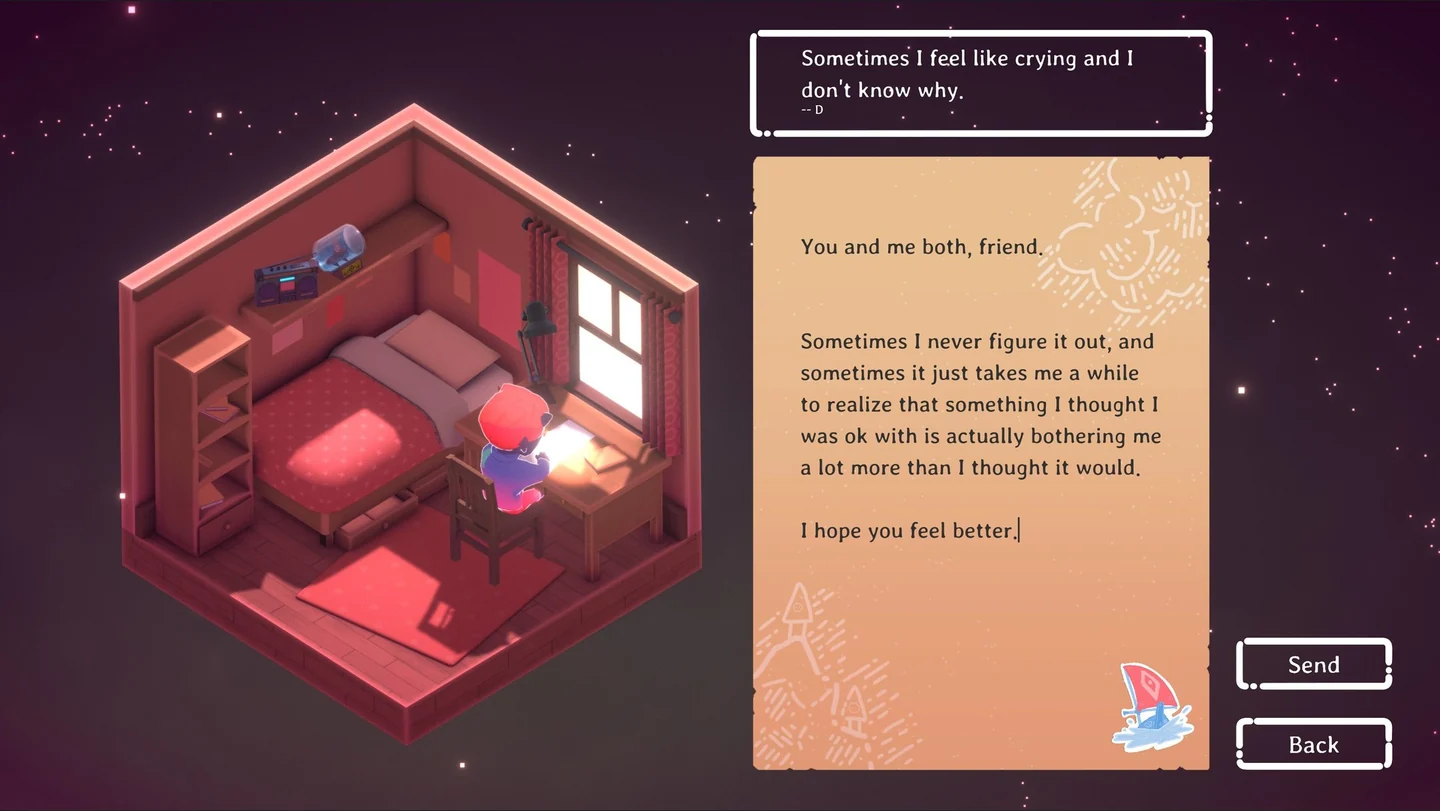
What replaces farming here is not a different resource chain. It is a social ritual: choosing a few useful words for somebody else. There is no landscape to navigate or customer order to optimize. The current official description also confirms that the original remains supported and that players of it and Kind Words 2 can write to each other; this entry is about the original game.
Choose it if giving and receiving gentle written company is what you want. Other people's requests can involve worries and sadness, so its cosy presentation does not guarantee emotionally light reading. Sticky Business is a better comparison if you want a creative ritual with fictional customer stories, and Spring Falls is the clearer pick if you would rather spend the evening entirely away from social interaction.
Game details & sources
Explore Kind Words (lo fi chill beats to write to) on Indie Lantern · Official Steam description
Official promotional screenshot. Popcannibal.
Which one should you actually start with?
If you are tired of keeping systems fed, start with A Short Hike for an outing, Tiny Glade for an open canvas, or Cats Organized Neatly for a contained problem. Those are three different answers to the same request for a quieter evening. None depends on persuading you that a crop calendar is relaxing.
If you miss the satisfaction of a routine rather than wanting to escape routine altogether, Sticky Business and Minami Lane provide a more structured replacement. Wobbledogs is for people who actively want pet care and experimentation. Spring Falls is for people who dislike agricultural chores but still enjoy bringing a green landscape to life.
The useful question is what you want to repeat, and what you want to stop doing. Player conversations about non-farming games often make exactly that distinction: some want to avoid plants; others want to avoid optimization, timers or endless errands. A game can remove farming and still contain the part that was wearing you out.
Sources and selection notes
These fifteen games are a starting point for finding a gentler activity, from exploration and puzzles to freeform building, small management loops and social writing. Farming is excluded as the central progression loop; puzzle flowers, gathering craft materials and pet care are explained where they appear.
Each game section links to its Indie Lantern page and current official Steam description. Screenshots are official promotional images from the credited creators. The comparison between freeform building and guided tasks is informed by a Tiny Glade player discussion; the distinction between farming and unwanted routines also appears in this CozyGamers discussion. These are individual perspectives, not a consensus or a performance test. Game descriptions and images were checked on November 18, 2026.